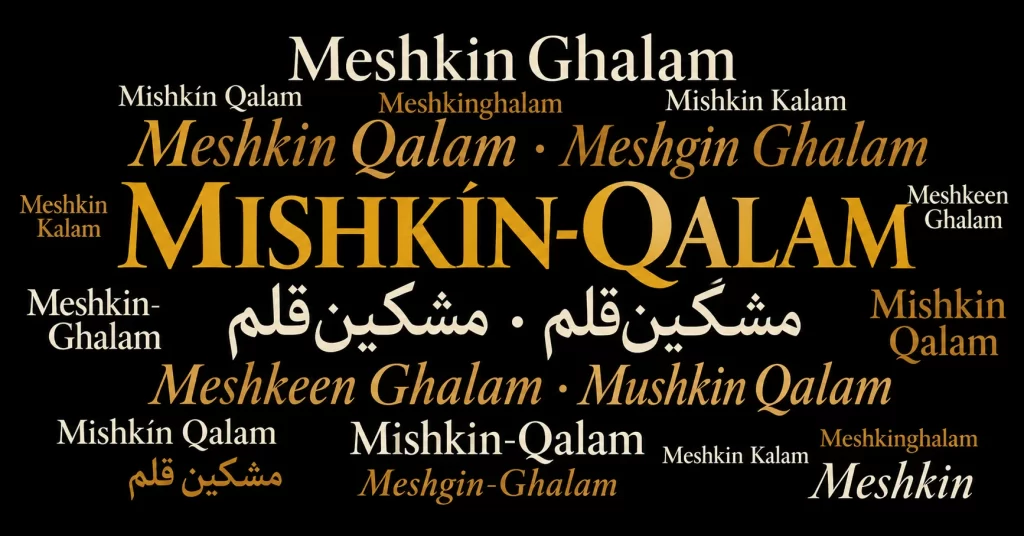
Mishkín-Qalam, Meshkin Ghalam, Meshgin Ghalam, Mishkin Qalam and Mushkin Qalam all name the same man: the Persian master calligrapher born Mírzá Ḥusayn-i-Iṣfahání (1824–1912), one of the nineteen Apostles of Bahá’u’lláh. In Persian his title is written مشکینقلم and pronounced mesh-keen qa-lam (IPA: [meʃˈkin ɢæˈlæm]). The English spellings differ because there is more than one way to put a Persian name into Latin letters, and four parts of this one can each be spelled in more than one way.
So if you searched for Meshkin Ghalam, Meshkin Qalam, Meshgin Ghalam, Mishkin Ghalam or Mushkin Qalam, you have found the right person.
What does Mishkín-Qalam mean?
Mishkín-Qalam is a title, not a birth name. Náṣiri’d-Dín Sháh, King of Persia under the Qajar dynasty, conferred it on him after the Grand Vizier (the prime minister) presented the young calligrapher at court, and it carries both colour and scent.
Mishkín comes from mishk, musk. The Dehkhoda dictionary gives the word two senses: anything “musk-laden”, carrying the scent of musk, and “black, black and dark”. The Moein dictionary agrees: “musk-laden; black and dark”. The link runs through everyday Persian too: Dehkhoda defines meshkí (مشکی), the ordinary Persian word for black, as “relating to musk”, “a dark red verging on black” and simply “black”, and “musk-coloured” (مشکرنگ) as “black, the colour of musk”. Fine Persian inks were scented too: a historic recipe for a black “peacock ink”, published by the Bodleian Library, finishes with rose water and musk. So mishkín describes ink that is jet-black and fragrant as musk.
Qalam is not a pen in today’s sense but the cut reed pen of Persian and Arabic calligraphy. Given to a person, the title means “the one who wields a reed (calligraphy) pen, flowing with musk-fragranced, jet-black ink”.
Translators have rendered it in several ways. A note to the English translation of ‘Abdu’l-Bahá’s Memorials of the Faithful explains that the name “means either musk-scented pen, or jet black pen”, and the scholar Annemarie Schimmel described him as “he with the musk black, fragrant pen”. This site uses “the Musk-scented Jet-Black Pen”, or “the Musk-Black Pen” for short.
How do you pronounce Mishkín-Qalam?
In Persian the name is said mesh-keen qa-lam, or [meʃˈkin ɢæˈlæm] in the International Phonetic Alphabet, with the stress on the last syllable of each word.
| Sound | IPA | How to say it |
| m | [m] | as in English |
| e | [e] | as in “mesh” |
| sh | [ʃ] | as in “she” |
| k | [k] | as in English |
| ee | [i] | between “keen” and “kin”: the vowel of “keen”, said quickly |
| n | [n] | as in English |
| q | [ɢ] | a deep “k” or “g” made at the very back of the throat, close to a French “r”; English has no such sound |
| a | [æ] | as in “lamb” (both a’s) |
| l | [l] | as in English |
| m | [m] | as in English |
The stress mark (ˈ) shows the stressed syllables: mesh-keen qa-lam.
Readers who know the name from Bahá’í books often say mish-keen ka-lam, following the spelling. Both are understood.
Why are there so many spellings?
Four parts of the name have no single English spelling.
- The vowels. Persian script does not write short vowels, and the first vowel of مشکین is one of them. Classical Arabic and older Persian pronounced it as a short “i”, and Bahá’í and academic transliteration follow those classical values, so they write mish. Modern Persian says it as “e”, so Persian speakers write mesh. The second vowel is a clear “ee”, a little shorter than in English “keen”. Classical Persian counted it as a long vowel, which is what the accent in Mishkín marks, while spellings like Meshkeen write it out. Mushkin, with a “u”, is a misspelling: it does not match how the title is said, and to a Persian ear it suggests a different word. It is listed here only because some auction catalogues, notably Sotheby’s, have used it.
- K, or G. Standard Arabic has no “g” sound, so the Arabic alphabet has no letter for it. Persian added گ (g), which is ک (k) with one extra stroke, but older Persian writing often left the stroke off and used ک for both sounds. The name is therefore read and written both ways, مشکین and مشگین, Meshkin and Meshgin, and both survive as family names among his descendants. The “g” is hard, as in “golf”, not soft as in “gem”.
- The letter ق. English has no matching sound. In Arabic, ق is a “k” made far back in the throat; scholars write it “q”, and the Bahá’í system follows them. In modern Iranian Persian, ق is pronounced the same as غ, a deep, voiced sound between a “g” and a French “r”, so Persian speakers usually write it “gh”, as in Ghalam. Others simplify it to “k”, as in Kalam.
- Two words, one title. Mishkín describes qalam, so the two words work as one title. Persian keeps them as two words, separated by a space or a half-space: مشکین قلم or مشکینقلم. English marks the link with a hyphen, Mishkín-Qalam, though you will also see two separate words, or the two run together as Meshkinghalam.
Common spellings: Meshkin Ghalam, Mishkin Qalam and more
| Spelling | Where you will see it |
| Mis͟hkín-Qalam | Bahá’í publications using the full transliteration, and this site |
| Mishkín-Qalam, Mishkín Qalam | Wikipedia, and Bahá’í books printed without the underline |
| Mishkin Qalam, Mishkin-Qalam | Everyday English, book titles, library records and auction catalogues such as Christie’s |
| Meshkin Ghalam, Meshkin-Ghalam | How Persian speakers usually write it in Latin letters |
| Meshkin Qalam, Meshgin Qalam, Mishkin Ghalam | Mixed spellings that combine the Persian and Bahá’í styles |
| Meshkeen Ghalam, Meshkeen Qalam, Mishkeen Qalam | Spelled as it sounds, mesh-keen |
| Meshgin Ghalam, Meshgin-Ghalam | Reading ک as g; also a family spelling |
| Mishkinqalam, Meshkinghalam, Meshkinqalam | Run together as one word, as in web addresses and social media handles |
| Mishkin Kalam, Meshkin Kalam | Simplified spellings that write ق as k |
| Mushkin Qalam | A misspelling found in some auction catalogues, such as Sotheby’s |
| Mishkin Qualam | A misspelling that adds a “u” after the “q”, as in English words |
| مشکینقلم، مشگینقلم | Persian |
| مشكين قلم | Arabic |
Why this site writes Mis͟hkín-Qalam
We follow the transliteration system adopted by Shoghi Effendi for Bahá’í literature and used by the Universal House of Justice. It gives Persian and Arabic names one uniform spelling, so a name is spelled the same way in every book. In it, “q” stands for the letter ق and the accent on “í” marks a long vowel. In printed Bahá’í books, a line under “sh” shows that the two letters stand for a single Persian letter, ش, rather than an “s” followed by an “h”. The system is a key to spelling, not to pronunciation, which is why it differs from how the name sounds in Persian today.
His full name
He was born Mírzá Ḥusayn-i-Iṣfahání (میرزا حسین اصفهانی), “Ḥusayn of Isfahan”; some sources give his name as Muḥammad-Ḥusayn. Persian sources often call him حسین مشکینقلم, Hossein Meshkin-Ghalam, and in everyday Latin spelling his birth name also appears as Mirza Hossein Esfahani or Mirza Husayn Isfahani. In Memorials of the Faithful, ‘Abdu’l-Bahá also refers to him with the honorific Jináb-i-Mishkín, roughly “the esteemed Mr Mishkín”.
Meshkin and Meshgin remain living family names, carried by his descendants, including the documentary’s executive producers, Dr Mehrdad Meshgin and Amir Válá Meshkin. Even one person’s name can appear both ways in print: the 1992 study Mishkín Qalam: 19th-Century Artist and Calligrapher spells Dr Meshgin’s name with a “g” in its preface and with a “k” in a footnote.
Not to be confused with
ʿAbd Allāh Mushkīn Qalam, a calligrapher in the service of Prince Salim, the future Mughal emperor Jahangir, around 1600. He bore the same honorific centuries earlier; a manuscript he completed in 1602 is held by the Walters Art Museum.
Frequently asked questions
Is Meshkin Ghalam the same person as Mishkín-Qalam?
Yes. Meshkin Ghalam is how Persian speakers usually write his title in Latin letters, and Mishkín-Qalam is the Bahá’í transliteration of the same title, مشکینقلم. Meshkin Qalam, Meshgin Ghalam, Mishkin Qalam and Mishkin Ghalam are other spellings of the same name.
What does Mishkín-Qalam mean?
It means “musk-scented pen” or “jet-black pen”: mishkín means both musk-scented and black, and qalam is the calligrapher’s reed pen.
How do you pronounce Mishkín-Qalam?
In Persian it is pronounced mesh-keen qa-lam ([meʃˈkin ɢæˈlæm]), with the stress on the last syllable of each word. The “q” is a deep sound made at the very back of the throat, close to a French “r”.
Who gave him the name?
Náṣiri’d-Dín Sháh, the Qajar king of Persia, gave him the title in recognition of his calligraphy.
Which spelling is correct?
Apart from Mushkin, which is a misspelling, none of them is wrong. Mis͟hkín-Qalam is the standard Bahá’í spelling, Mishkin Qalam is the common English form, and Meshkin Ghalam is closest to how the name sounds in Persian today.
Explore his life and work
- His full biography, from the royal court to exile in Cyprus and his final years in ‘Akká
- His calligraphic works, including his design of the Greatest Name
- The award-winning documentary about his life
Sources
‘Abdu’l-Bahá. “Mishkín-Qalam.” In Memorials of the Faithful, translated by Marzieh Gail, 97–101. Bahá’í Publishing Trust, 1971. https://reference.bahai.org/en/t/ab/MF/mf-37.html.
Bahá’í Reference Library. “The Transliteration System Used in Bahá’í Literature.” Bahá’í International Community. https://www.bahai.org/library/transliteration/1.
Bodleian Libraries. “Persian Recipes: Black Inks.” University of Oxford. https://www.bodleian.ox.ac.uk/about/libraries/our-work/conservation/persian-recipes/black-inks.
Christie’s. “A Baha’i Calligraphic Panel, Signed ‘Abd al-Baha’ Mishkin Qalam, Ottoman Akka, Dated Dhu’l Hijja AH 1319/March–April 1902 AD.” Lot 167, Art of the Islamic and Indian Worlds including Rugs and Carpets, sale 22675, London, April 25, 2024. First accessed July 2026; last accessed November 5, 2026. https://www.christies.com/en/lot/lot-6476632.
Dehkhoda, ʿAlī-Akbar. Loghatnāmeh [Dictionary] (لغتنامه دهخدا). Vol. 13, 20961, 20969–70, s.vv. “مشک,” “مشکرنگ,” “مشکی,” “مشکین.”
Dihlavī, Ḥasan. Dīvān-i Ḥasan [Collection of poems]. Copied by ʿAbd Allāh Mushkīn Qalam, Allahabad, 27 Muḥarram 1011 AH/1602 CE. Ms. W.650, Walters Art Museum. https://thedigitalwalters.org/Data/WaltersManuscripts/html/W650/description.html.
Moein, Mohammad. Farhang-e Fārsi [Persian dictionary] (فرهنگ فارسی معین). S.v. “مشکین.” Amir Kabir, n.d.
Society for Persian Letters and Arts. Mishkín Qalam: 19th-Century Artist and Calligrapher. With an introduction by Vahid Rafati and a note by Annemarie Schimmel. Landegg Academy, 1992. https://www.bahai-library.com/6865.
Sotheby’s. “A Calligraphic Panel with Confronting Cockerels, by Mushkin Qalam, Probably Akka, Palestine, Dated 1317 AH/1899 AD.” Lot 56, A Princely Collection: Treasures from the Islamic World, sale L10225, London, October 5, 2010. First accessed July 2026; last accessed November 5, 2026. https://www.sothebys.com/en/auctions/ecatalogue/2010/a-princely-collection-treasures-from-the-islamic-world-l10225/lot.56.html.