In the Name of the One God, the Most Glorious
A Note on the Age and Year of Birth of
Jináb-i-Mishkín-Qalam
the Renowned Bahá’í Calligrapher
(1824 – 1912)
Arman Arian
Concerning the year of birth of Jináb-i-Muhammad-Husayn-i-Isfahání, who bore the title “Mishkín-Qalam,” there exist at least two prominent accounts. The one holds that he was born in or about the year 1810; the other regards 1826 as nearer the truth.
This disparity in the year of his birth impels us towards a more searching inquiry, and to seek out fresh and trustworthy evidence. Such evidence may well lie concealed among his own works and writings — above all in those panels whose date and signature, together with the year of their execution, have preserved for us, as a lasting memento, his age as well.
That the year of his birth should be neither precise nor certain is hardly to be wondered at, given the customs of the ages that preceded the introduction of the national identity certificate in Iran; nor was the birth year of Jináb-i-Mishkín-Qalam any exception to this rule. Only the year of his passing, 1912, is known with certainty.
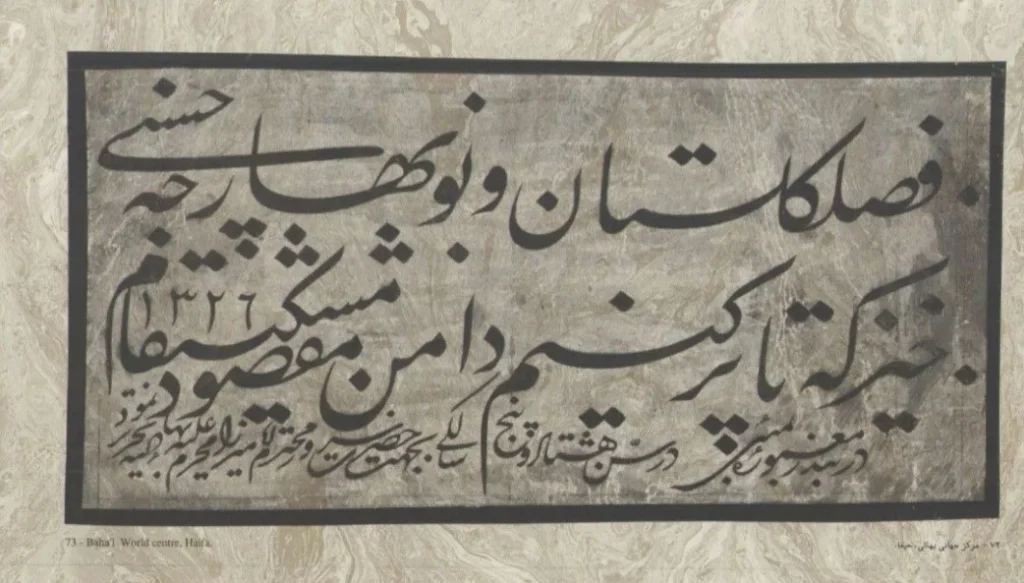
On the first of the works in question (Figure A), he himself records — in the year 1326 AH, corresponding to 1908 AD, in the land of India — that he is eighty-five years of age. Some four years later, therefore, when he ascended to the Abhá Kingdom in ‘Akká, he would have been approximately eighty-nine years old.
The approximation in this reckoning arises because the name of the month in that lunar year is not made clear at the foot of the inscription; for this reason, and owing to the drift of the lunar months against the solar, the exact Gregorian year and month cannot be determined.
Be that as it may, on the strength of such testimony as the date and the age set down beneath the panel by that calligrapher — himself one of the Apostles of Bahá’u’lláh — it suffices to subtract eighty-five years from the 1326 AH inscribed beneath the panel, that is, from 1908 AD, in order to arrive, with the greatest precision attainable, at the year in which Jináb-i-Mishkín-Qalam was born.
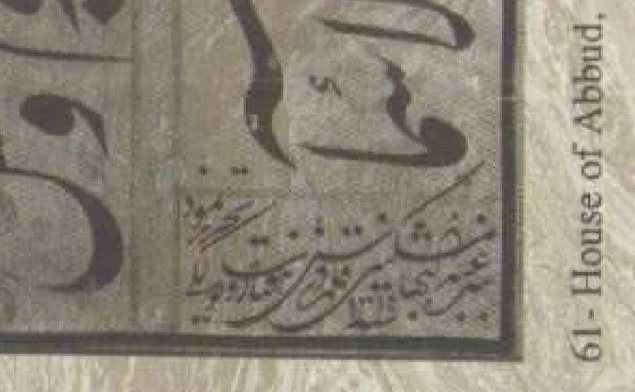
The second panel, against which the age and date of the first may be tested, is that shown in Figure B, signed thus: “Written by the servant of ‘Abdu’l-Bahá, Mishkín-Qalam, at the age of seventy-two. In the year 1314 AH.”[1] That year corresponds to 1896 AD, which, on the assumption of a birth year of 1823, yields a discrepancy of one year in Mishkín-Qalam’s age — a consequence of the differences among the lunar, solar and Gregorian calendars. It is this that leads us to place Mishkín-Qalam’s birth, by the Gregorian reckoning, somewhere between 1823 and 1824.
The signature on the third panel (Figure C), which likewise bears a precise age and date, will assist us in refining our hypothesis yet further: “The servant of ‘Abdu’l-Bahá, Mishkín-Qalam, set down this page at the age of eighty, in the illumined city of ‘Akká — in the year 1322.”[2] This corresponds to 1904 AD, and when the eighty years he mentions are subtracted, it too brings us precisely to a birth year of 1824.
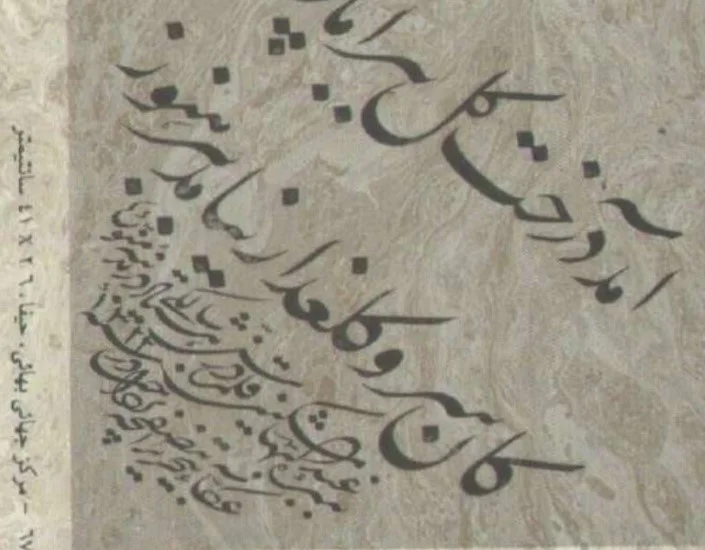
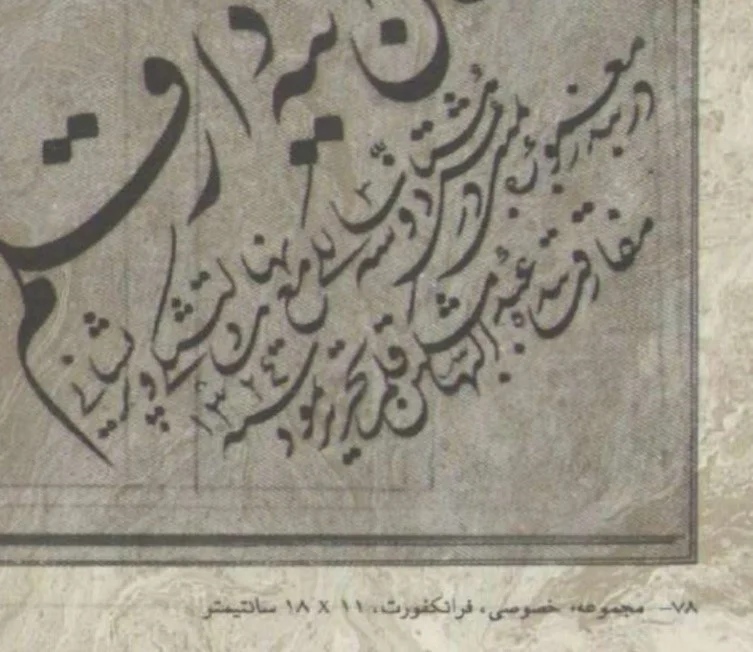
The fourth panel (Figure D) bears the date 1324 AH (probably in the closing months of that year),[3] corresponding to 1907 AD, and on it Mishkín-Qalam describes himself as eighty-three years of age: “In the flourishing port of Bombay, at the age of eighty-three, with the utmost longing and the anguish of separation, the servant of ‘Abdu’l-Bahá, Mishkín-Qalam, wrote this — in the year 1324.”[4] Once again, therefore, we arrive at 1824 as the year of Mishkín-Qalam’s birth.
A point worthy of note emerges here. Judging by the works that have come to light, it was in the seventh and eighth decades of his life that Mishkín-Qalam began to inscribe his age beneath his works — a practice that may, in some measure, betoken a new awareness within him of the need for a faithful record of his works and of his life. For as the sun of his life drew towards its setting, and the Cause of God steadily advanced, he must surely have known that ere long his works would be beheld and studied in every quarter of the globe. He therefore sought to convey to those who would one day behold them as much as he could, both of fact and of the feelings that stirred within him in the hour of creation — feelings that had grown twofold in their intensity amid the loneliness of his exile in India, far from his Master.
| Age | Lunar Hijri | Gregorian |
|---|---|---|
| Age 72 | 1314 AH | 1896 AD |
| Age 80 | 1322 AH | 1904 AD |
| Age 83 | 1324 AH | 1906 AD |
| Age 85 | 1326 AH | 1908 AD |
In sum, by collating the four works above, each bearing both the calligrapher’s age and its date, the year 1823 — or, more precisely, 1824 — is proposed as the year of Jináb-i-Mishkín-Qalam’s birth. This corresponds to the year 1202 of the solar Hijri calendar and 1239 of the lunar, and falls twenty years before the dawn of the Badí‘ calendar of the Bahá’í Faith.
On this basis we find that Jináb-i-Mishkín-Qalam was seven years younger than Bahá’u’lláh and five years younger than the Báb. He was, moreover, twenty-two years older than ‘Abdu’l-Bahá, seventy-five years older than Shoghi Effendi, and nine years older than Yahyá Azal.
Proceeding in the same manner, we may determine Jináb-i-Mishkín-Qalam’s age at certain momentous events in the early days of the Bábí and Bahá’í Faiths — figures which are, in their own right, of no small interest:
| Year | Mishkín-Qalam’s Age | Significant Event |
|---|---|---|
| 1824 (probably winter) |
Birth | Birth of Jináb-i-Mishkín-Qalam into a Shírází family in Isfahan (his parents being Fátimih Khánum and Hájí Muhammad-‘Alí, a merchant of Isfahan). |
| 1844 | Age 20 | The dawn of the Bábí Faith in Shíráz. |
| 1848 | Age 24 | The passing of his father (according to oral history). This is the very year of the death of Muhammad Sháh and the accession of Násiri’d-Dín Sháh to the throne. If Mishkín-Qalam’s journey to settle his father’s commercial affairs is likewise to be placed in this year, or even within the four years that followed — that is, up to the close of 1851 — then the Grand Vizier (Prime Minister) at the time of the episode in the bazaar, which led to Mishkín-Qalam’s entry into the court of Násiri’d-Dín Sháh, was Amír Kabír. |
| 1867 | Age 43 | Attains the presence of Bahá’u’lláh in Adrianople[5] (Ottoman Edirne). In this year he began to write for the Cause of God, and had not yet adopted his celebrated signature, “Bandiy-i-Báb-i-Bahá, Mishkín-Qalam” (“the servant at the gate of Bahá”).[6] |
| November 1868 | Age 44 | Mishkín-Qalam’s exile to Cyprus (aboard the same ship that bore Bahá’u’lláh to His exile in ‘Akká).[7] |
| 1878 | Age 54 | Release from eleven years’ confinement in the fortress of Famagusta in Cyprus (according to the signature on the panel “Bismi’lláhi’l-Ghaníyyi’l-Abhá” — “In the Name of God, the All-Possessing, the Most Glorious” — in the International Bahá’í Archives, Haifa).[8] |
| 1884 | Age 60 | The beginning of his final two years of exile, in the town of Larnaca, Cyprus, during the period of British rule that succeeded the Ottoman.[9] |
| 14 September 1886 | Age 62 | Complete release from the island of Cyprus, and voyage by ship into a self-chosen exile in ‘Akká, in the presence of Bahá’u’lláh.[10] |
| Spring 1890 | Age 66 | Meeting with Edward Granville Browne in ‘Akká.[11] |
| 1892 | Age 68 | The Ascension of the Promised One, the Beloved, Bahá’u’lláh. |
| 1893 | Age 69 | Calligraphy of the blessed Kitáb-i-Íqán (The Book of Certitude) by Bahá’u’lláh[12] and of the Risáliy-i-Siyásiyyih (Sermon on the Art of Governance) by ‘Abdu’l-Bahá.[13] |
| 1898 | Age 74 | Engraving of the marble casket for the sacred remains of the Báb. |
| 1905 | Age 81 | Journey to India, at the behest of ‘Abdu’l-Bahá, for the publication of Bahá’í books;[14] Mishkín-Qalam’s sojourn in India continued until at least 1907.[15] |
| 6 December 1912 | Age 88 or 89 | The ascension of Jináb-i-Mishkín-Qalam to the Abhá Kingdom, in ‘Akká.[16] |
Autumn and winter 1401 SH (2022–2023)
Arman Arian
Written alongside the final stages of production of the feature-length documentary Mishkín-Qalam
By Arman Arian · Translated from the Persian
[1] From the book Mishkín-Qalam: Nineteenth-Century Artist, p. 55, panel 61 — House of ‘Abbúd, the room of Munírih Khánum.
[2] Ibid., panel 67 — Bahá’í World Centre, Haifa.
[3] Strictly speaking, by the precise pattern that emerges from his signatures beneath the four sample panels, this ought to have read 1325 AH; otherwise we must accept that he reached the age of eighty-three between the middle and the close of 1324 AH — a conclusion which may, in some measure, also bring us nearer to the approximate month of his birth, in the autumn or winter.
[4] Ibid., panel 78 — private collection, Frankfurt.
[5] “The Life and Works of Mishkín-Qalam,” by Dr. Mehrdad Mishkin, 1983, p. 7. (A Persian translation of this article was also published in two consecutive issues of Payám-i-Bahá’í, July and August 2021.)
[6] As shown by panel 58 in Mishkín-Qalam: Nineteenth-Century Calligrapher-Artist, p. 53.
[7] A Traveller’s Narrative Written to Illustrate the Episode of the Báb, Edward G. Browne, p. 380.
[8] Browne, however, in A Traveller’s Narrative, places this in 1879 and gives Mishkín-Qalam’s age as fifty-three (A Traveller’s Narrative Written to Illustrate the Episode of the Báb, Edward G. Browne, p. 378).
[9] A Traveller’s Narrative Written to Illustrate the Episode of the Báb, Edward G. Browne, p. 388.
[10] Encyclopaedia of Religion and Ethics, vol. 2, ed. James Hastings, p. 303.
[11] A Year Amongst the Persians, Edward G. Browne, p. 366.
[12] Asráru’l-Áthár, Fádil-i-Mázandarání, vol. 1, p. 268.
[13] A Tablet of ‘Abdu’l-Bahá.
[14] “The Life and Works of Mishkín-Qalam,” Dr. Mehrdad Mishkin, 1983, p. 14.
[15] According to the ‘Abdu’l-Bahá panel — Mishkín-Qalam: Nineteenth-Century Artist, p. 57, panel 64.
[16] Historical Dictionary of the Bahá’í Faith, Hugh C. Adamson, p. 299.